
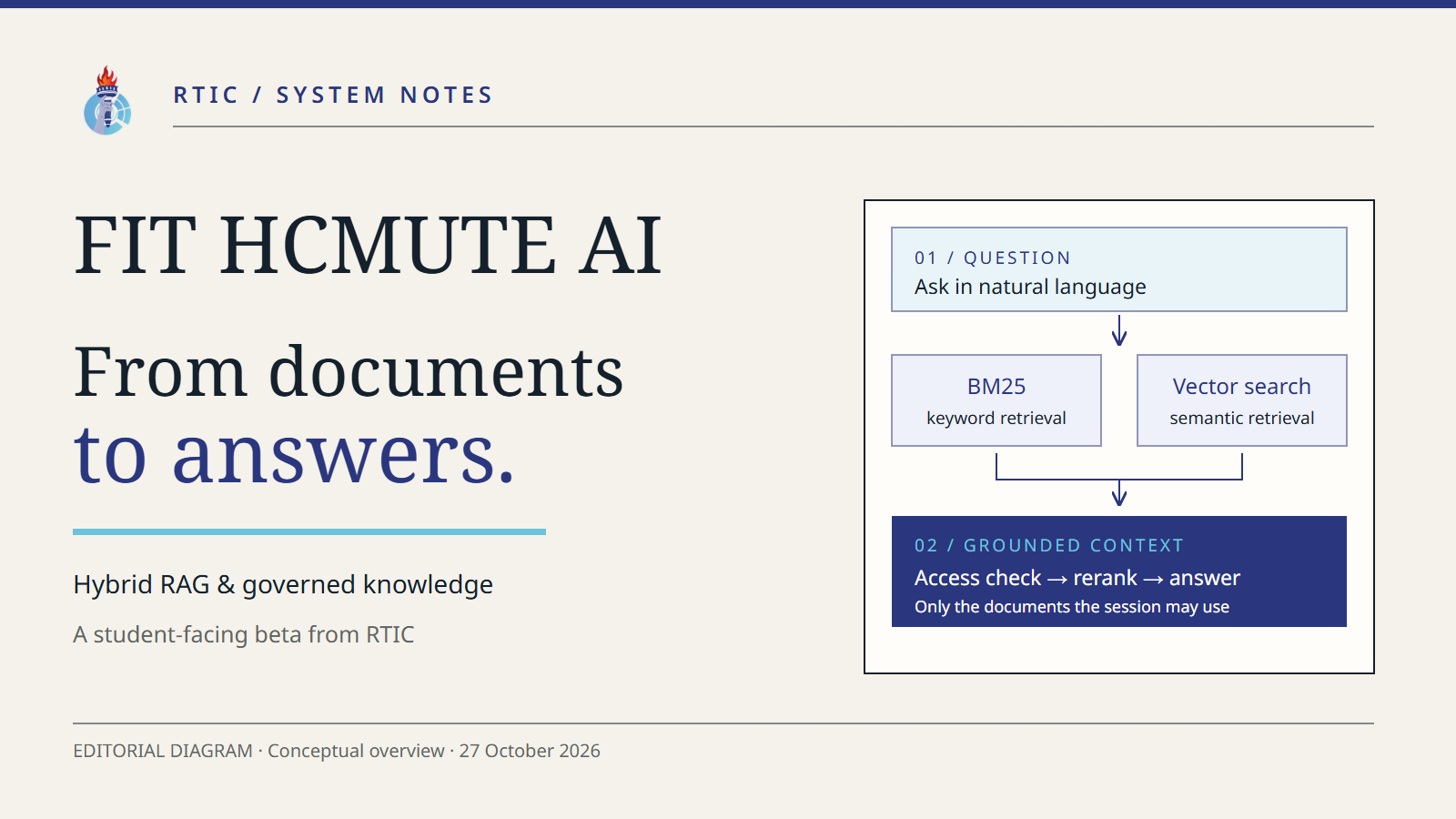
Finding a training regulation, a course description or a student announcement should not require knowing the exact page title in advance. Trợ lý AI FIT HCMUTE, developed and operated by RTIC, explores a conversational way to navigate this information.
The service is a beta reference tool. It complements the Faculty's published documents and human support; it does not replace official notices or guarantee that every question has an answer in the available knowledge base.
Start with the public experience
The interface supports Vietnamese conversations and streamed responses. A separate handbook provides a document catalog with filters and search. These are related experiences, but not the same search algorithm: the handbook currently uses text matching over catalog fields, whereas chat has a Hybrid RAG retrieval path.
A visitor can use the available guest experience; account-based features use the assistant's own Google sign-in flow. This is separate from the Journal website's GitLab account system.
From a question to an answer
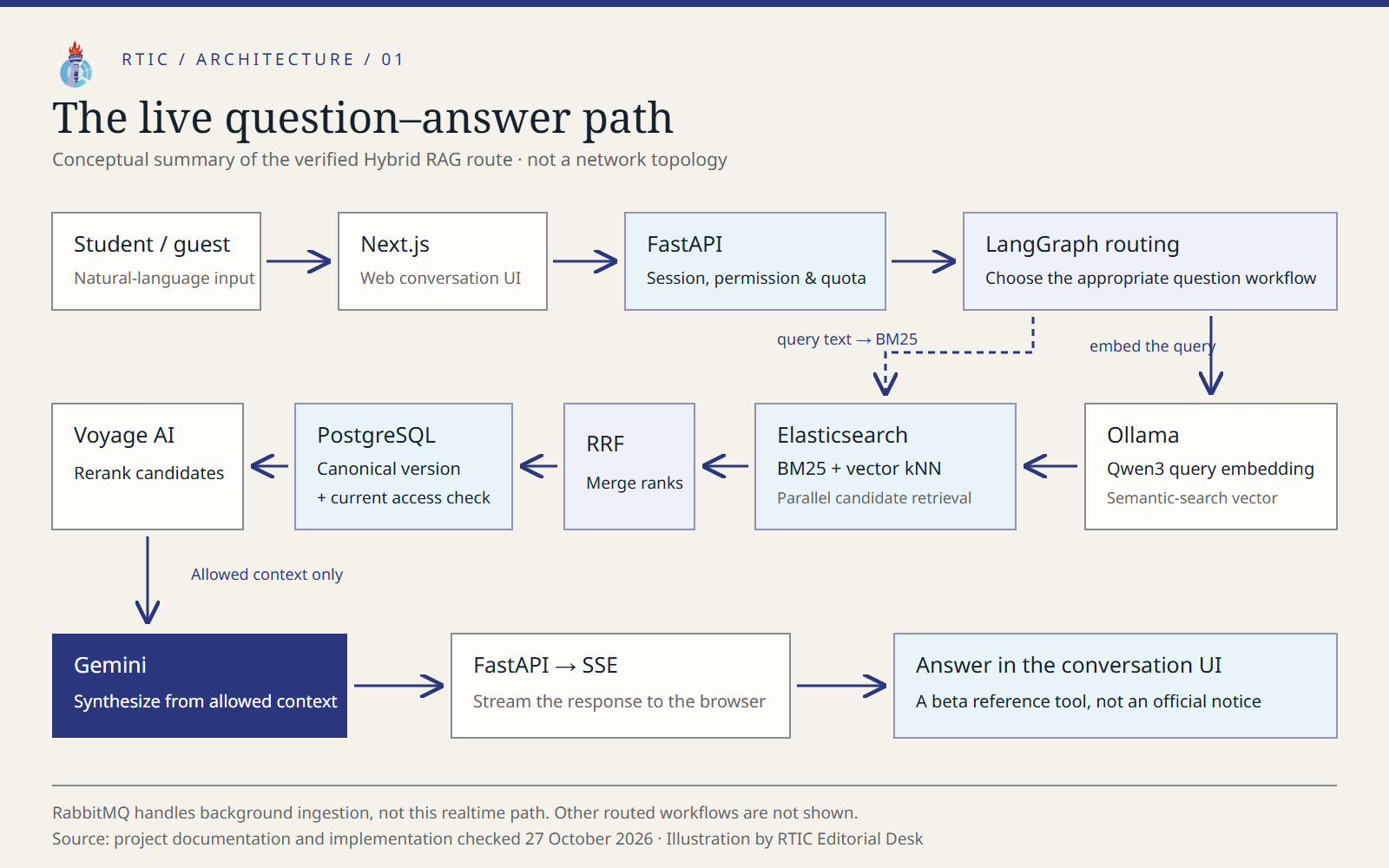
Figure 1. The document-grounded answer route, summarized on 27 October 2026. Open the full-resolution diagram. LangGraph selects the workflow appropriate to the question.
The web application sends a question to FastAPI, which checks the session, permissions and request budget. LangGraph routes the question to an appropriate workflow.
For retrieval-augmented answers, query text supports BM25 matching while an embedding produced through Ollama supports vector kNN search. Elasticsearch runs these retrieval modes and RRF merges their rankings. The next stages check canonical document versions and access in PostgreSQL, rerank candidates, and let the language model synthesize an answer from the allowed context. The response is streamed back to the interface using SSE.
In the configuration checked for this article, the stack uses Qwen3 Embedding 8B through Ollama, Voyage AI for reranking and Gemini for answer generation. Providers and model selections can change; the architecture and responsibility of each stage matter more than a permanent model-version claim.
Ingestion is a different workflow
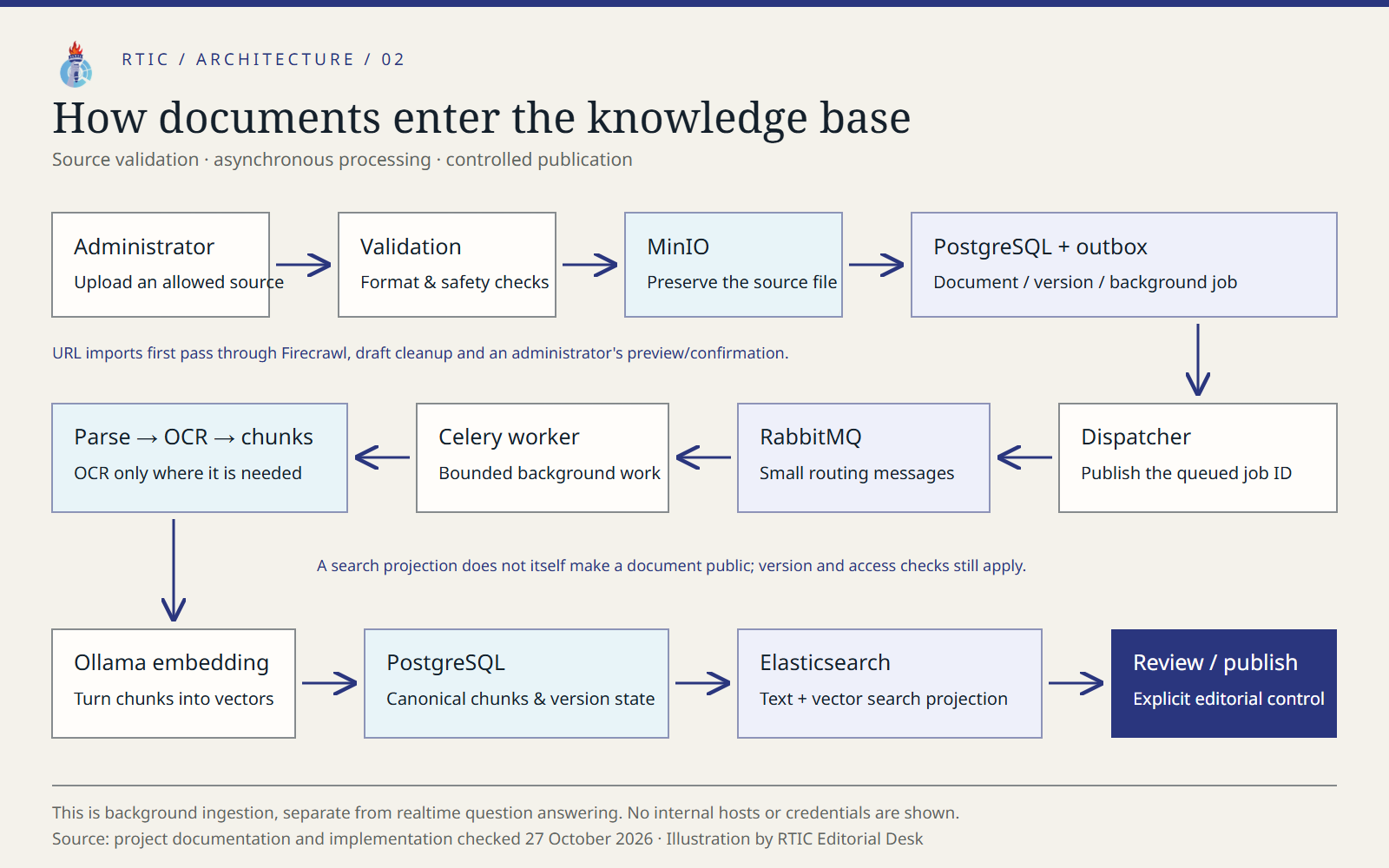
Figure 2. Background ingestion, deliberately separated from realtime chat. Open the full-resolution diagram. A search projection is not permission to publish a document.
Administrators manage the source material. Files pass validation and are stored with document/version/job metadata. A dispatcher and RabbitMQ/Celery handle background parsing, selective OCR, chunking and embedding. PostgreSQL retains canonical state; Elasticsearch holds the search projection. Publication and document access remain explicit controls.
URL imports have a preview step: extraction through Firecrawl is followed by cleanup and an administrator's confirmation before entering the common ingestion pipeline.
RabbitMQ is not on the realtime answer path. It carries background jobs, not each streamed chat response.
Why the document lifecycle matters
Retrieval quality starts before a question arrives. Version tracking helps the system distinguish updated material from older copies. Access checks limit which retrieved passages can become answer context. Review controls determine which documents are available to readers. Together, these stages connect the answer to managed knowledge rather than leaving freshness and permissions to the language model.
The current interface keeps source-grounding metadata internally and does not display citation cards for every answer. For academic decisions, use the handbook and the Faculty's original notices to check the relevant regulation and its effective date. Coverage is limited to material that has actually been reviewed and made available.
An invitation to use it carefully
Try questions grounded in the Faculty's published material, inspect the relevant official documents when making academic decisions, and provide feedback when an answer is incomplete or stale. The quality and coverage of a document-grounded assistant depend on both the retrieval pipeline and the knowledge that has actually been reviewed and made available.
Made by RTIC — HCMUTE Research on Technology and Innovation Club. Article and original architecture diagrams: RTIC Editorial Desk, based on the public product and project documentation checked on 27 October 2026.